
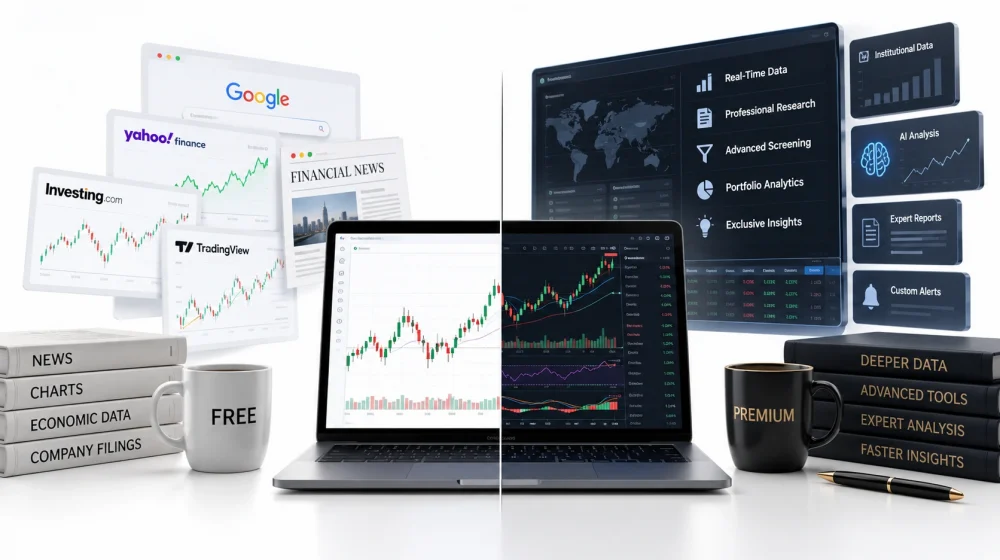
Traders and investors now have access to an enormous amount of market analysis for free, including news, charts, economic calendars, company filings, earnings data, and commentary from independent analysts. At the same time, premium research platforms continue to charge significant subscription fees for tools, data, and curated insights that may appear similar on the surface. The real question is not whether paid research contains information unavailable anywhere else, but whether it delivers that information faster, more efficiently, or in a form that improves decision-making enough to justify the cost.
What investors can realistically get from free market analysis
Free sources can provide enough information for many investors to research markets effectively, especially when they are willing to compare several platforms and do more of the analytical work themselves. Public financial websites, exchange data, company investor-relations pages, regulatory filings, economic databases, and news outlets can cover much of the information needed for basic market research.
Investors can usually find historical price charts, financial statements, earnings calendars, valuation ratios, analyst commentary, macroeconomic indicators, and breaking market news without paying for a subscription. Many charting platforms also provide free technical indicators and watchlists. The trade-off is that information may be spread across different sources, delayed, limited in depth, or surrounded by advertising.
What paid market analysis services usually offer
Premium platforms generally sell convenience, depth, speed, and specialized tools rather than simply charging users to see information that could never be found elsewhere.
- More detailed datasets. Paid services may provide longer historical series, institutional ownership data, detailed estimates, alternative datasets, or more granular market information.
- Advanced screening tools. Subscribers can often filter securities using more financial, technical, and fundamental criteria than free platforms allow.
- Faster or real-time data. Some subscriptions include lower-latency quotes, news feeds, economic releases, or professional-grade market data.
- Curated research. Premium services may provide analyst reports, model portfolios, investment theses, sector research, and structured summaries.
- Integrated workflows. Data, charts, alerts, research, portfolio analytics, and screening can be combined in one platform, reducing the time spent switching between sources.
For some users, this time savings can be more valuable than access to any individual piece of information.
Where free sources tend to fall short
The main limitation of free market analysis is often fragmentation rather than complete lack of information. An investor may need one website for company filings, another for economic data, another for technical charts, and several different news sources to build a complete picture.
Free platforms may also restrict historical depth, limit the number of indicators or alerts, delay quotes, or provide only simplified financial metrics. Some services offer useful data but make it difficult to export, compare, or analyze efficiently.
Another issue is quality control. Free commentary can range from high-quality research to speculation designed primarily to generate clicks. Investors therefore need to spend more time evaluating the credibility of each source and distinguishing analysis from opinion or promotion.
Does paying for research actually give investors an information advantage
Paid research can create an efficiency advantage, but it does not automatically create a profitable informational advantage. Many premium services analyze information that is already publicly available, such as earnings releases, economic reports, company filings, and price data.
The value may come from processing that information faster or organizing it more effectively. A professional platform can save users hours by automatically calculating ratios, comparing companies, monitoring estimates, or sending alerts when important conditions change.
However, paying for research does not guarantee that the conclusions will be correct. Markets can react unpredictably even when analysis is thorough. Investors should therefore treat premium research as a decision-support tool rather than assuming that subscription fees purchase superior returns.
How to judge whether premium analysis is worth the subscription price
The value of a paid service should be measured against the specific problems it solves for the user rather than the number of features listed on its pricing page.
- Identify what you actually need. Determine whether you require faster data, better screening, deeper company research, technical tools, macroeconomic analysis, or simply easier access to information.
- Compare with free alternatives. Check whether the same information can be obtained elsewhere without payment and estimate how much additional work that would require.
- Test the workflow. Use a trial period where available and measure whether the platform genuinely saves time or improves your research process.
- Compare the price with account size. A subscription that appears inexpensive can still consume a meaningful percentage of returns for a small investment account.
- Evaluate results over time. Determine whether you actually use the features regularly and whether they contribute to better-informed decisions rather than simply providing more information.
A platform that saves several hours every week may be valuable to an active professional while offering little benefit to someone who makes only a few long-term investment decisions each year.
Red flags to watch for in paid market analysis services
Premium pricing should not be confused with professional quality, and some research services rely more heavily on marketing than on useful analysis.
- Guaranteed performance claims. No legitimate research provider can reliably promise specific investment returns without risk.
- Selective success stories. Highlighting a few profitable recommendations while ignoring unsuccessful ones can create a misleading impression of accuracy.
- Constant urgency. Repeated countdowns, limited-time offers, or pressure to subscribe immediately can indicate a marketing-focused business model.
- Unclear methodology. Providers should explain how their research is produced and what type of analysis supports their conclusions.
- Difficult cancellation policies. Complicated renewal terms, hidden fees, or unclear refund conditions can make an otherwise useful service poor value.
Investors should be particularly cautious when a service focuses more on predicted profits than on research quality, uncertainty, and risk.
Who is most likely to benefit from paid market research
Premium research is most valuable to users whose investment process is frequent, data-intensive, or time-sensitive. Active traders may benefit from real-time information, advanced alerts, and detailed technical tools. Professional investors and analysts may value efficient screening, deeper datasets, and integrated research workflows.
Investors managing complex portfolios can also benefit from portfolio analytics, risk measurements, and access to consistent company and macroeconomic data in one place. In these cases, subscription fees may function as a productivity expense rather than simply a payment for investment ideas.
By contrast, a long-term investor who buys a small number of diversified funds or researches only a few companies each year may gain relatively little from an expensive professional platform.
When free market analysis is enough and when paying makes sense
Free market analysis is often sufficient when an investor has a straightforward strategy, trades infrequently, and is comfortable gathering information from several reliable sources. Public filings, economic databases, financial news, and free charting tools can support a surprisingly sophisticated research process.
Paying becomes more reasonable when the investor needs better data organization, faster information, advanced screening, specialized datasets, or significant time savings. The decision should therefore depend on how much practical value the service adds to the user’s workflow rather than whether the information appears more professional.
The best approach is often to begin with free resources and identify specific limitations before purchasing anything. Once those limitations become clear, a paid platform can be evaluated against a defined need. Premium research can be valuable, but only when its benefits in speed, depth, organization, or efficiency exceed both the subscription cost and the value of the free alternatives already available.